
Crucial steps to take when faced with structural roof damage due to poor installation, inspection or design.
When a roof is found to have any structural damage or partial failure, it is important to immediately get the right professionals and competent persons involved for the roof repairs. At this stage, getting a general contractor or even regular roofing contractor involved, will not be of much help. In fact, I have found that out of a genuine desire to help, general contractors have more often aggravated the issue than improve it. Such an example will be highlighted later in the article.
Another important fact to consider before we look at the points to remember for structural roof repairs is the application of the Construction Regulations of 2014. This has been gazetted over 10 years ago (in Construction Regulation 2003 9(4)) and yet, very few property owners are aware of this until a structural failure occurs and a claim arises.
As part of the OCCUPATIONAL HEALTH AND SAFETY ACT 85 OF 1993, and CONSTRUCTION REGULATIONS, 2014, Section 11(2) states:
“An owner of a structure must ensure that:
- Inspection of that structure are carried out periodically by competent persons in order to render the structure safe for continued use;
- That the inspections contemplated in a) above are carried out at least once every six months for the first two years, and thereafter yearly;
- The structure is maintained in such a manner that it remains safe for continued use;
- The records of inspections and maintenance are kept and made available on request to an inspector”
Even though legal claims pertaining to this depends very much on evidence to prove negligence and might be hard to prove, owners of commercial property are urged to comply to this regulation to ensure safe working environments and avoid any possible claims. The roofs that are most commonly susceptible to structural failure have been found to be large span (over 10m) timber roofs with concrete roof tiles. The good news is that this reduces the risk for most residential roofs, but on the other hand includes most commercial buildings.
Important points to remember
Initial measures
- The very first course of action to take when any structural defect or failure of a timber roof is spotted is to vacate and restrict access to the affected area. Keep in mind that this can be a much larger area than what is evidently seen and rather vacate the entire area underneath the damaged roof.
- As mentioned before, immediately contact the appropriate competent persons who specialise in structural timber roof failures. Keep in mind that a professionally registered structural engineer will have to oversee the repairs and approve any remedials, so that a new certificate for the roof can be issued after repairs.
- It’s also good to make sure the professional structural engineer has adequate professional indemnity insurance and has experience in this field. Most are happy to provide proof of this if requested.
A bit of not so common, common sense
- With structural damage to timber roofs, sagging down of the bottom chords in areas are very common. Emergency props need to be installed underneath the failing members but should NOT be propped back into position yet. Often, general contractors have tried to help by doing this and in the process further disturbed the already fragile roof structure. Such practice is dangerous and can initiate catastrophic failure. The purpose then of the emergency props, is simply to avoid further sagging until loads can be safely removed from the roof. When the roof loads are removed, members can be lifted back into position.
- When removing the main roof loading (i.e. concrete tiles), it is crucial to remember to do it symmetrically, starting on the worst affected area.
During roof repairs
- Any remedial details have to be clear, approved or drawn up by a competent engineer and carefully applied.
- The use of wood screws (anodized hex head) is encouraged instead of nails for much better holding strength.
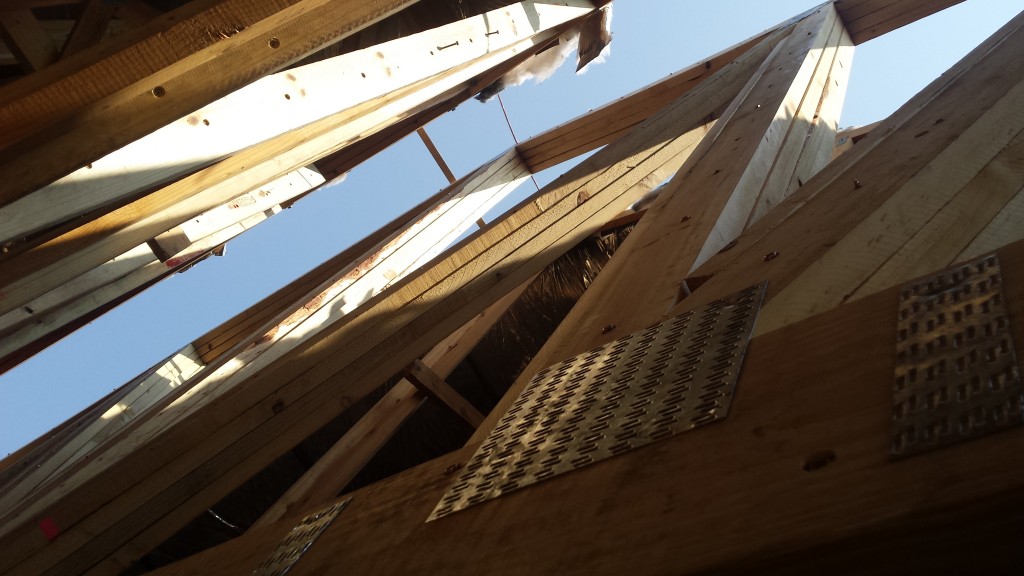
- Where steel nail plates have been torn out of tension members, plywood gusset plates with screws are a good solution when the members are back in position.
- In some older roofs, even though the trusses might have been prefabricated, there are often large areas with no trusses or non-triangulated trusses. This is often found at short setback hip-over valley areas and some trusses will have to be purpose made for this. Often, your engineer will specify the required member sizes and this can be given to a reputable roof truss manufacturer to fabricate or make on site according to specification.
- Special attention needs to be given to all girders, not just those in an affected area. The reason being that after repairs are done, if there are still inadequacies in other roof areas, the next weakest link may fail. Restraining the girder top chords are of paramount importance, along with ensuring the multiple plies of girders are acting as one and have not delaminated.
Final thoughts
- Important to consider is also the general design of the roof and often your engineer might insist on the redesign of some trusses and especially girders to make sure that the original design was adequate. If it is found not to be, he will prescribe the relevant remedial and in severe cases advocate truss or girder replacement.
- Before reloading the roof, it is crucial that the competent person or engineer inspect and approve the structure with its repairs. Again the roof needs to be loaded symmetrically and the structure monitored during this process.
- Finally, don’t be afraid to insist on the credentials, proof of indemnity insurance and experience of the team you choose for your repairs. It is our responsibility as members of the industry to improve it for the good of all, but I encourage the end-user to hold industry members accountable by insisting on verifiable credentials.
REMEMBER: The cost of doing roof repairs right the first time is always much less than having to redo it later.
Click HERE to see which SERVICES we can offer relating to roof repairs.
This article was edited and published in the April 2016 Edition of SA Roofing Magazine. Read it HERE (p.4 & 18-20).
For the details of a professionally registered structural engineer, well studied in timber roof repairs and registered with the Institute for Timber Construction, click HERE.