
“THE SUCCESS OF A SAFE ROOF STRUCTURE LIES IN THE “FINER DETAIL”
The interaction between Roof Inspector & Roof Erector is critical for a safe roof structure. This is an Inspector’s perspective, kindly provided to us by Tinus de Jager.
Tinus has been in the timber roof inspection field for the last 16 years and has specialist knowledge and experience in structural roof failures.
He can be reached at Tinusdj@hotmail.com or +27 72 179 7033.
For Tinus’ registration details at the Institute for Timber Construction, click HERE.
Many insightful and relevant articles have been published during the past few years about the Roof Truss Industry and the role of the Institute for Timber Construction (ITC), with its affiliated members.
For many years a lot of emphasis has been placed on the Engineering Systems, the quality control of the engineered product (trusses) and the rules that apply to the erecting process of the structures, in accordance with the relevant SANS Codes & practices.
The importance of these aspects ought to be published more frequently on every available social media outlet by the experts in the industry.
Home owners need to be made aware of their responsibilities in appointing Professionals to oversee the processes of their newly erected structures.
Finer detail:
The focus of this article is specifically aimed at the “finer detail” contained in the Roof Erecting Standards & Procedures Manuals.
This industry is fortunate & blessed with many highly qualified, knowledgeable & experienced people.
The timber Engineering industry is probably as well equipped, structured and organized as any other industry.
The question begs repeatedly however: Why are catastrophic roof structure failures, in this day and age, still prevalent?
The lack of news coverage on these events, leads us to believe the myth, that all is fine in this industry.
It is quite disturbing that these incidents do not make news headlines and subsequently leaves us in a space of complacency and we are actually living in a false reality.
The sad & disturbing reality is that all is NOT fine in the industry and it is not because structures are inadequately engineered or manufactured.
They are poorly erected & poorly inspected !!
We have state-of-the-art tools to design and manufacture very complex roof structures. We certainly have the means to provide the end-user with a safe roof.
My experience during the past 16 years of roof inspections on timber roof structures, has time and time again, confirmed my conclusion, that most failures are a direct result of poor, or in some cases, no assessments of these structures, prior to their occupation.
The ultimate responsibility, which should lie with the Competent person or Engineer who performs the final assessment, is somehow just brushed aside to make space for ‘excusitis’.
The “fate” or “serviceability” of a structure is determined largely by a thorough assessment of the structure by a competent person, prior to the application of loads to the structure.
Inspections are being done in various ways and it is worrying that in some cases they are even done “remotely”. This practice is not only unethical, but dangerous and criminal.
Consciousness and mindfulness seems to be a very scarce commodity amongst some inspectors.
How then, should assessments be conducted for a safe roof?
Inspectors are trained to have the required design documentation at hand during an inspection, which is vital in checking that the appropriate, design specific requirements are met.
Together with the design output there should be extensive knowledge of the well published, Roof Erecting Procedures, contained in the SANS 10243 & SANS 10400 (L) Codes of Practice, as well as, the ITC Roof Erecting Handbooks.
In a recent publication of the SA Roofing Magazine, an expert explained, amongst other very important topics, the importance of bracing in a roof structure.
The importance of bracing cannot be over emphasized, but this emphasis should go one step further to ensure a safe roof………
This has prompted me to expand a little on this very relevant and critical topic, in light of recent catastrophic timber structure failures.
The implementation/application of the bracing detail, is where problems are created and the only person that can practically identify these inadequacies is the Roof Inspector.
My view is that:
“ Bracing is only as effective as its connection (nailing) to the primary roof structure ”
A quick glance during an assessment of a completed structure might, more often than not, create a false sense of compliance, nl. that all bracing members are visibly present in their designated positions and therefore the structure appears to be adequately braced.
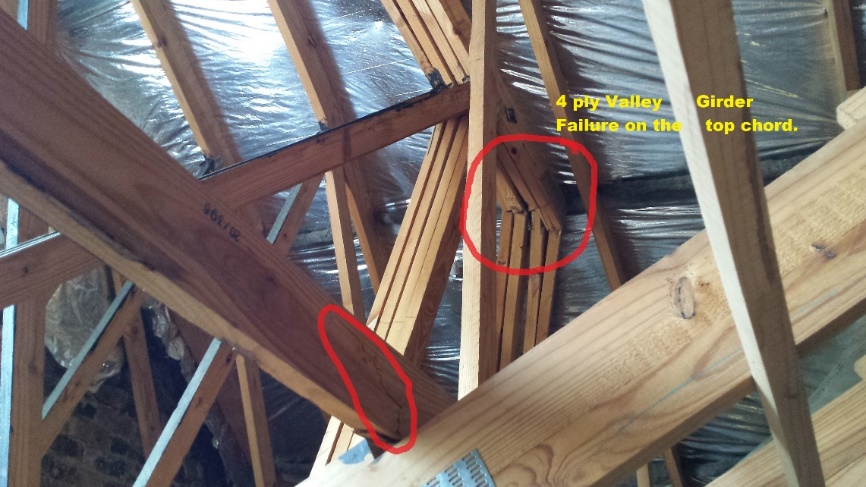
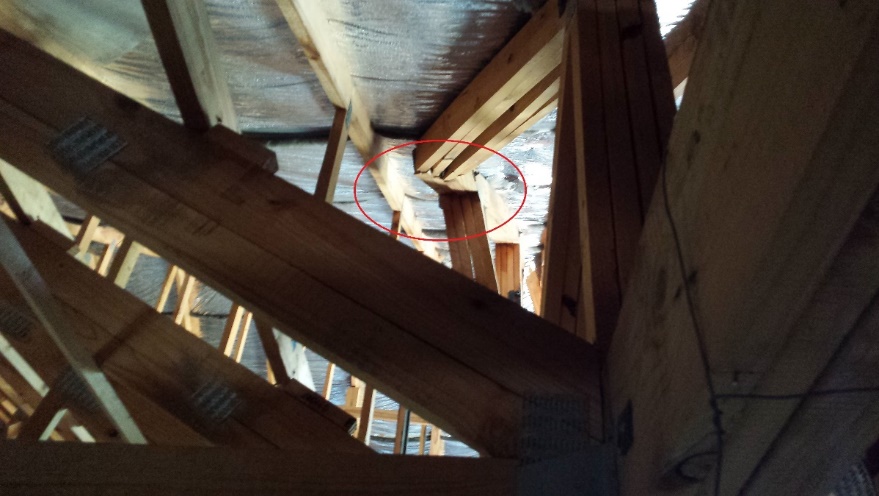
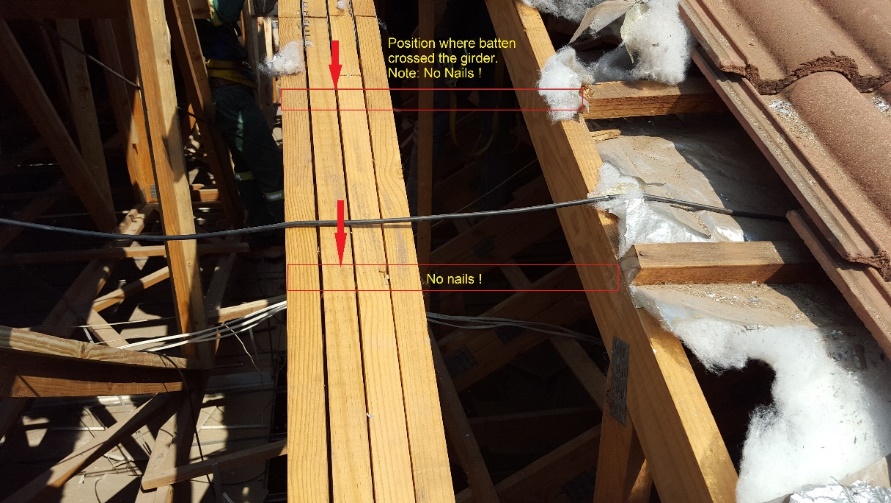
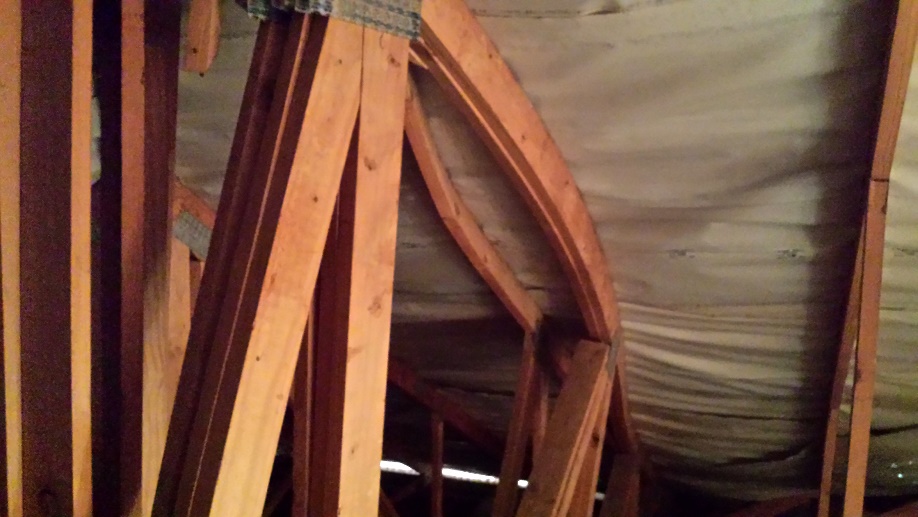
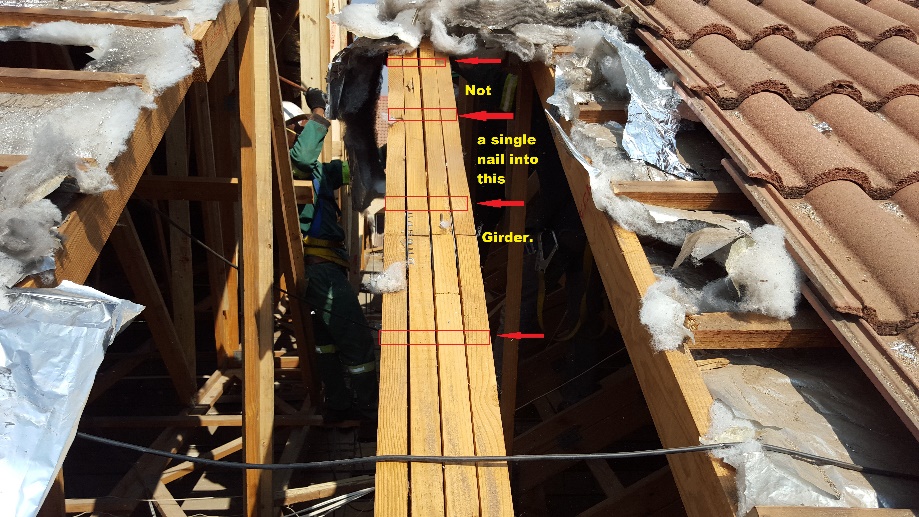
On closer inspection (As I will prove by the following photographs) these members are either inadequately fixed or not fixed at all.
These connections, whether they are screws or nails, are critical in ensuring an effective bracing system.
If one considers that structures are mostly designed optimally, for structural, as well as, economical reasons, there is No room left for additional negligence during the erecting phase.
Every misplaced or incorrectly fixed nail or screw will compromise the strength of a joint or connection & can have far reaching consequences. !!
The “method of nailing” is quite clear in the SANS 10243. P. 16
For example :
The general perception amongst Roof Erectors is that battens are fitted only as a means of securing roof tiles, but their purpose goes much further than that.
They are actually critical in ensuring the reduction of the effective length of the rafter members, against buckling, ESPECIALLY where multiple ply Girders are involved.
Numerous cases, as I have witnessed, have proven that this inadequacy in combination with other non-compliances, can create the perfect mixture for a catastrophic failure.
When should inspections be conducted to ensure a safe roof?
- It is generally accepted that inspections on new structures should be done prior to the permanent loads (Roof covering) being applied. Unbraced or partially braced structures are doomed to fail once the loads are applied. There should be no compromise on this.
- Any modifications or alterations/additions to a structure should be inspected in conjunction with the relevant rational design of such additions or modifications.
- Property owners must be made aware that roof structures must be checked REGULARLY according to a vital clause in the Construction Regulation 9(4) of 2003.
Roof Erectors
Poorly trained & unqualified artisans, unfortunately feature at the core of this problem.
The lack of understanding of the basic roof Erecting Principles & procedures has led to a multitude of bad practices in the industry for many years.
The proliferation of these bad practices, over the years, has ensured that many roof structures have now become monuments of construction inadequacies, which contradict basic design assumptions.
This means that these structures will NOT perform in the long term and we are now witnessing the inevitable after effects of this.
Failures of roof structures, I am afraid, have become and will become more prevalent in future.
Inspectors.
Dedicated and passionate Roof Inspectors have for many years been mentors to some of the Roof Erectors.
They have provided assistance, guidance & unofficial training on site, to many Roof Erectors, without any compensation. This will undoubtedly remain so until adequate official training is offered in the future.
This has subsequently resulted in the Inspector becoming the “quality controller” for these “contractors”.
One could perhaps hope for the introduction of written & practical tests being done to each of the currently accredited Erectors, before renewal of their new annual membership.
We might have to re-visit the way in which Roof Erectors are evaluated for their competency to be accredited with the ITC.
Too many of them just don’t meet the requirements in my opinion.
The following six points is a very simple guideline that might help in ensuring the Criteria for a
“SAFE ROOF”:
- All trusses must be erected straight & plumb.
- Ensure that all bracing, as per the design requirements, has been installed.
- All multiple ply Girders must be bolted & nailed or preferably screwed together in accordance with the ITC requirements and SANS 10243.
- All cleats must be fully bolted & truss hangers fully nailed & bolted where required.
- Torsional restraints must be installed at Girders for all incoming supported trusses, as per the design specifications.
- Fly rafter restraints must be installed to all truncated trusses & truncated girders.
Note :
These six points for a safe roof involve a substantial amount of “finer detail” that has to be complied with in order to make them effective. The fine print on this detail has to be studied and applied carefully to ensure a safe roof.
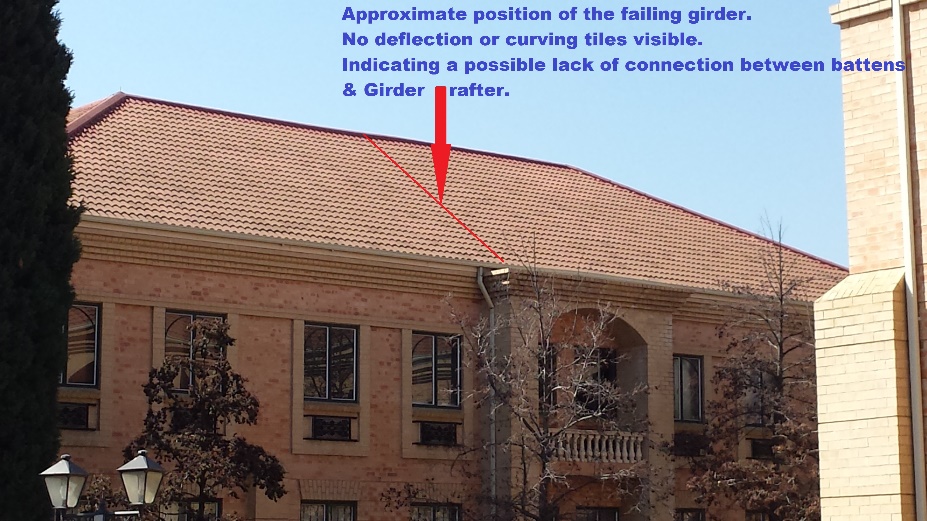
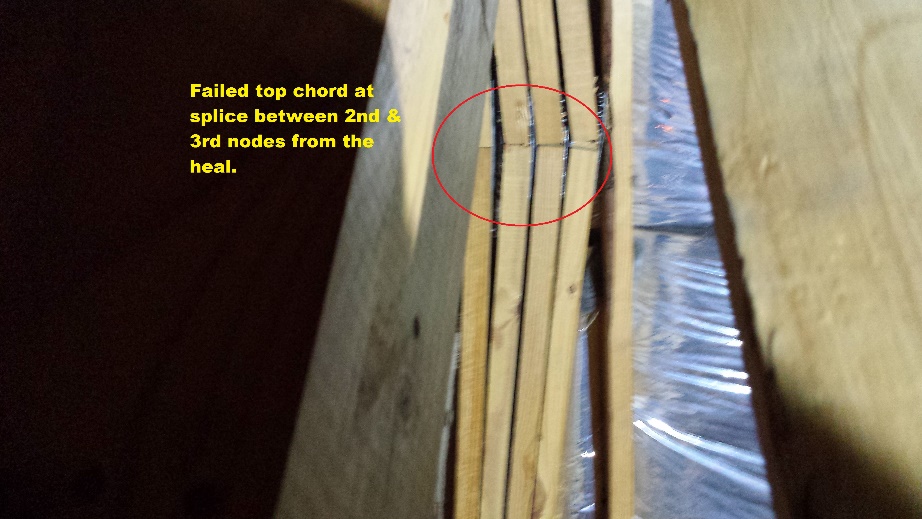
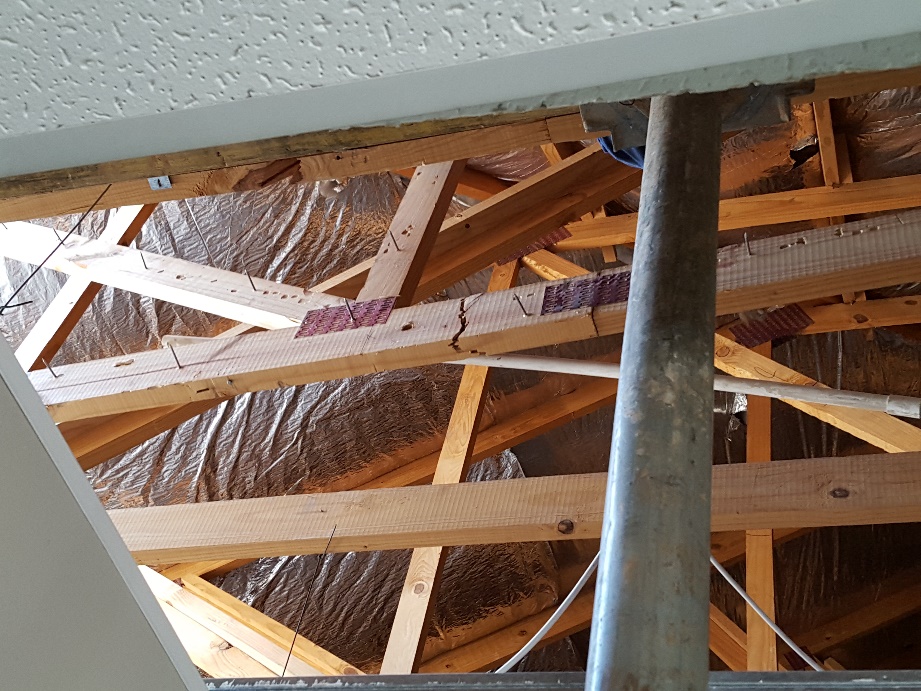
The following photographs represents only a fraction of typical roof erecting errors that are committed daily in the industry.

REMEMBER: It’s our responsibility as industry members to ensure a SAFE ROOF to the end-user.