Roof Failure: On Dangerous Ground
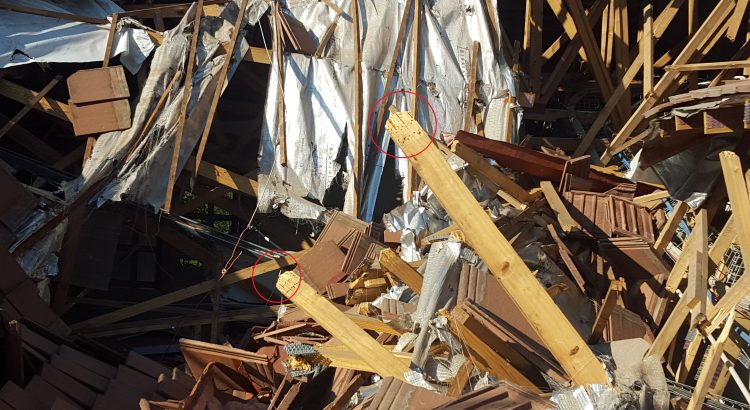
The serious problem of structural roof failure and the concern around the frequency with it occurs received much-needed attention in the previous edition of SA Roofing. It is no coincidence that, here, we address another disastrous collapse.
Information provided by Tinus de Jager, Certified Inspector (SAQA); ITC-COC/0125/INS
Article as published in SA Roofing: May 2016 Edition HERE.
Last month, while SA Roofing was talking to certified roof inspector Tinus de Jager about his article on roof structure failures (that appeared in the April edition), he informed us that he had just received an urgent call to investigate yet another structural roof failure. The roof failure, which had been discovered by the building tenants, occurred in perfect weather just after employees had started leaving for their homes that afternoon.
The owner, understandably very worried as this happened at the start of a long weekend, contacted the ITC-SA (the Institute for Timber Construction SA) for the names and numbers of engineers or inspectors who might be available to assist. Eventually, the contractor was able to reach de Jager, who was glad to help.
–
ACTION TAKEN
As a start, the immediate area was cordoned off with barrier tape, and the building was rendered completely off limits to all employees. Once on site, de Jager was accompanied by the main contractor and a safety officer and given a brief safety induction. They proceeded to enter the first floor where the collapse had occurred, to do an inspection of the area. They needed to determine the condition of the remaining roof sections on both sides of the collapse in order to make recommendations on which steps to take, to ensure that the sections were made safe enough to allow for further clearing up activities.
It was safe enough for the tenant to remove sensitive documents, furniture, computers and personal belongings that had not been completely damaged or destroyed, from the building.
It was agreed that de Jager would do a further assessment of the remaining roof structure the following day. Subsequent to his second inspection, de Jager concluded that the entire remaining roof structure was unsafe for continued use. Steel-covered scaffolding walkways were then constructed throughout all the passageways on the first floor, to enable people to come in and remove all their remaining valuables.
–
FINDINGS
In explaining why this collapse occurred, de Jager says it is not a clear-cut case. “I would hesitate to claim what the primary cause for failure was, but from experience, I am quite certain that it was a combination of bad practice, ineffective remedial work, and the possibility of manufacturing errors,” he says, adding, “The latter, however, can only be confirmed once, or if ever, the original design documentation can be obtained.”
There were also numerous examples of non-compliance with standard roof erecting procedures. De Jager concluded that previous remedial work was ineffective and inconsistent and probably aggravated the situation in some instances. A combination of all the above factors just made it impossible for the structure to perform, ultimately resulting in the failure.
–
NEXT STEPS
De Jager recommended that the building be evacuated as soon as possible and that the current roof structure be removed to allow for the construction of a new roof structure. This was by no means an easy recommendation, he states. “I must make it clear that a decision like this is not made lightly, as the cost implications are enormous. People’s safety, however, remains the overruling priority in such findings.”
A tender process will now be initiated for the supply and installation of a new roof structure. Special attention will be given to ensure that the contractor responsible for the erection of the new roof is capable and qualified for the job. Quotations for the supply of the trusses will be carefully scrutinized to ensure that all design requirements in terms of additional loads as well as bracing materials and sundries have been taken into account. The final designs will also have to be checked by the respective systems engineers. This is a standard procedure followed with regard to all systems for public buildings.
The final designs will also have to be checked by the respective systems engineers. This is a standard procedure followed with regard to all systems for public buildings.
–
PREVENTION
Could this collapse have been prevented? “The first thought that came to my mind was that a thorough visual inspection should have been done just after the erection of the structure,” de Jager says. “Many of the inadequacies could and would have been noticed then and could have been addressed or rectified immediately.”
An annual structural inspection, as is now required by law, should have taken place a year after the initial construction. De Jager feels certain that such an assessment would surely have picked up the first signs of failure, or at least have revealed non-compliances in terms of the basic Roof Erecting Procedures.
–
ROLE OF THE INSPECTOR
De Jager feels strongly that inspectors must get more involved, and he references Regulation no. 8 under the new Construction Regulations, which makes provision for the appointment of a Competent Person by the Principal Contractor to oversee a particular section of a project, where the size and risk profile of the project necessitates the supervision of such construction. “Roof inspectors should not be shy to offer their services to clients, especially the owners of commercial buildings, to ensure that roofs are being erected correctly.
This service will ensure that correct procedures are being followed during the erection phase and that poor habits and incorrect practices are eliminated.” De Jager says that, in his experience, owners are willing to pay for such a service. “For this purpose, I am in the process of drafting a guideline to assist erectors in following a sequence of effective roof erecting procedures that will eliminate the bad practices that have caused so many failures to date.”
“I have no doubt that, if proper supervision takes place during the erection process to ensure compliance with general good practice, we will make great strides in eliminating roof failures in the future,” he concludes.
–
This article was kindly provided to us by Tinus de Jager.
Tinus has been in the timber roof inspection field for the last 16 years and has specialist knowledge and experience in structural roof failures.
He can be reached at Tinusdj@hotmail.com or +27 72 179 7033.
For Tinus’ registration details at the Institute for Timber Construction, click HERE.
roof failure roof failure roof failure